

How much do party rentals cost in Dallas-Ft. Worth? This is the part you can pin down early. We’ll go through what each category costs here, put your guest count through the calculator for an estimate, and cover the local details that move that number.
We’ll also get into what separates a Dallas event from a Fort Worth one, how spring storms and summer heat shape your date, and what the Stock Show does to a January calendar. Know those pieces up front, and the rest of the planning starts to feel like the fun part!
- Estimate What Your Dallas-Ft. Worth Event Will Cost
- How much does it cost to rent tables in Dallas-Ft. Worth?
- How much does it cost to rent chairs in Dallas-Ft. Worth?
- How much does it cost to rent linens in Dallas-Ft. Worth?
- How much does it cost to rent bar and glassware in Dallas-Ft. Worth?
- How much does it cost to rent lounge furniture in Dallas-Ft. Worth?
- How much does it cost to rent decor in Dallas-Ft. Worth?
- How much does it cost to rent inflatables in Dallas-Ft. Worth?
- What Else You Need to Know About Planning an Event in Dallas-Ft. Worth
- Venues in Dallas-Fort Worth
- Need Party Rentals in Dallas?
Estimate What Your Dallas-Ft. Worth Event Will Cost
Enter your guest count, select the categories you’re renting, and you’ll get an estimate for the items priced below.
Calculate Approximately How Much Party Rentals Will Cost
Estimate what rentals might cost for your event. We've filled in the basics — add or remove items to see what changes.
Estimated rental cost
—
Rentals only — delivery, setup and damage waiver are quoted separately.
Why a range? Picking your table and chair styles below narrows it. The rest of the spread comes from the other categories — the low end assumes a practical setup, the high end a more formal one.
What's included
Tick anything on or off. Open a row to see what's behind the number.
Real prices depend on your dates and what's available.
See rentalsDelivery and setup. Not included above. Budget roughly $150 to $200 for delivery in most metro areas, and more if the site sits well outside the metro or the load-in needs extra labor — walk-ups, freight elevators and after-hours windows all add time.
Damage waiver.
Totals cover rentals only — not venue, food or staffing.
How much does it cost to rent tables in Dallas-Ft. Worth?
A 60-inch round seats 8 with formal place settings, or 10 at a casual buffet. Formal settings are what take it down to 8, because 3 glasses and 4 pieces of flatware per person crowd the space around each seat. Use 8 wherever guests stay at the table through dinner. For 200 guests that puts you at 25 rounds with formal settings, and 20 if the meal is a buffet.
Squares are the other seated shape worth a look. A 60-inch square also seats 8, and a 72-inch square takes 12, which keeps a big family group at one table.
Long rectangles are the shape for a family-style meal, with the food set down the center of the table for guests to share. An 8-foot rectangle seats 8 to 10. If your date is out in the Grapevine vineyard area, or at one of the farm and ranch venues across Collin, Denton, and Parker Counties, long runs of rectangles suit those rooms well.
Cocktail tables are a separate count, and the ratio depends on whether there’s a meal. For a standing reception, plan 1 cocktail table for every 4 or 5 guests. Where dinner is seated and the cocktail tables only work the hour beforehand, 1 per 10 guests does the job. Keep 30 to 36 inches of open floor around each one, so a group can gather without closing off the walkway.
Leave room in the count for the tables that hold things: the buffet, the gift table, and the cake.
Table pricing across the metro usually looks like this:
Tables
| Item | Typical day rate |
|---|---|
| Specialty & Picnic Tables | ~$40 |
| Cocktail Tables | ~$20 |
| Square Tables | ~$17 |
| Round Tables | ~$15 |
| Rectangular Tables | ~$14 |
How much does it cost to rent chairs in Dallas-Ft. Worth?
Chairs work out at 1 chair per guest, and it’s worth adding a couple of spares for the head table and whoever confirms at the last minute. Style is the open question here, and the answer follows from how long people will stay in their seats.
- Poly folding chairs. Light, stackable and unpadded. That is what makes a fast flip possible, so two people can reset a room while guests are outside with a drink. Nobody notices a bare seat during a 30-minute ceremony.
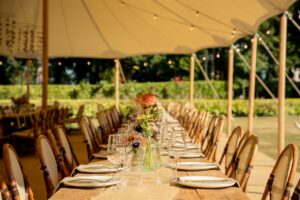
- Chiavari and luxury chairs. The formal choice, in gold, silver, white, black or wood. They arrive finished, so you can leave covers and sashes off the order. These are padded, so they’re more comfortable for formal, seated dinners.
- Barstools. A few barstools give guests somewhere to sit during the standing hour, at the right height for your cocktail tables.
- Benches and other seating. The pick when you are setting long tables and want the room informal. Nobody has an assigned seat, so guests sit where they land and slide down to make room, which suits a family-style dinner or a casual party more than a formal one. Ask your vendor how many each bench takes, and set your chair count against that.
For a gala or a wedding dinner where guests are at the table for hours, we’d point you to the padded chair. Where the party is casual and people are on their feet most of the night, folding chairs are plenty.
Chair rates around Dallas-Ft. Worth:
Chairs
| Item | Typical day rate |
|---|---|
| Benches & Other Chairs | ~$29 |
| Barstools | ~$19 |
| Luxury & Chiavari Chairs | ~$10 |
| Folding Chairs | ~$4 |
How much does it cost to rent linens in Dallas-Ft. Worth?
Linens come off your table order: 1 per table, plus a napkin per guest for a seated meal. Size is the part worth writing down, because each cloth is cut for one table and one drop:
- A 60-inch round takes a 120 to reach the floor, or a 108 to stop at lap height with the legs visible.
- A 60-inch square takes a 108 down to the floor and a 90 for the shorter drop.
- An 8-foot banquet table takes a 90 by 156 for full length, and a 60 by 120 for the shorter one.
- A 30-inch highboy takes a 108 all its own, since a cloth cut for a dinner table won’t sit right on a cocktail table.
Floor length is the more formal of the two looks, which is where a Park Cities gala tends to land. Overlays and toppers layer a second fabric over the base cloth, so you can work in another color without changing every linen on the order. Napkins can pick up the base color or bring in the second one. Chair covers and sashes sit on the same order sheet, and they’re what brings a folding chair into your palette.
Typical linen rates in the Dallas-Ft. Worth area:
Linens
| Item | Typical day rate |
|---|---|
| Round Linens | ~$18 |
| Rectangular Linens | ~$18 |
| Square Linens | ~$15 |
| Chair Covers & Accessories | ~$3 |
| Napkins | ~$2 |
How much does it cost to rent bar and glassware in Dallas-Ft. Worth?
Ask your venue what’s already in the room. Some spaces have a bar built in, and others hand you a corner and an outlet. Where there’s nothing built in, a portable bar is what gives your bartender a station, with the glassware within reach and the ice and bottles tucked underneath.
Someone has to be behind it. Venues generally require a certified bartender and do not allow guests to pour for themselves. Ask early who that person is coming from, since it can be the caterer, the venue itself, or a separate bar service.
For quantities, figure about 1 drink per guest per hour, which puts a 4-hour reception for 200 guests at roughly 800 pours. Glass counts follow that total, and your guest number alone won’t get you there. This is because one person can easily go through 2 glasses in an evening, a wine with dinner and something mixed afterward, and an empty glass doesn’t find its own way back to the bar rinsed. With that in mind, order against the drinks you expect to pour. Where the venue washes glassware on site, about 25% fewer will cover you.
Two more numbers that make ordering easier:
- Wine. A 750ml bottle pours about 6 glasses. Planning on 5 gives you a little room.
- Champagne. A toast takes 1 flute per guest, and 1 bottle covers 8 guests at a half glass each.
Here’s the going rate for bar and glassware around Dallas and Fort Worth:
Bar and glassware
| Item | Typical day rate |
|---|---|
| Bars | ~$210 |
| Specialty Glasses | ~$1 |
| Wine & Champagne Glasses | ~$1 |

How much does it cost to rent lounge furniture in Dallas-Ft. Worth?
Plan on roughly 1 grouping per 100 guests. A grouping gives guests somewhere to sit that isn’t a dinner table, which is where an evening goes once the plates are cleared.
Corporate events are a big share of what gets planned around here, with AT&T, American Airlines, Toyota and Lockheed Martin all based in the metro, and a networking reception or a product launch is where lounge seating does its best work. There are no place cards at a reception, so the pieces you order are the only places to sit.
Here’s what you’re putting together:
- Sofas and settees. The anchor of the grouping, and the pieces that tell guests this corner is meant for sitting. A sofa sets the tone for the entire vignette.
- Chairs and ottomans. These fill in around the sofa. Square ottomans are the useful ones, because they add seating without walling off the group, so somebody can join a conversation already going.
- Coffee tables and side tables. Somewhere to set a drink down, which is half the reason anybody stays in the seat. Coffee tables and side tables both serve that role in a well-arranged grouping.
Set the groupings along the edges of the room where people can hear each other, and keep a clear path between them and the bar.
What lounge furniture pieces run in Dallas-Ft. Worth:
Furniture
| Item | Typical day rate |
|---|---|
| Lounge Furniture | ~$575 |
| Sofas & Settees | ~$298 |
| Chairs & Ottomans | ~$130 |
| Coffee Tables & Side Tables | ~$68 |
| Other Furniture | ~$50 |
How much does it cost to rent decor in Dallas-Ft. Worth?
How much decor you need comes out of the room itself. A space that already looks finished takes very little.
Where a hall is bigger than your guest list, pipe and drape closes off the space you aren’t using so the room fits the party. It will also cover a service door or a stack of equipment. No published sizing rule exists for drape, so measure the length you want covered and quote that measurement to the vendor.
Stanchions hold a walkway open across a busy floor and keep a check-in area in order, which earns them a place at a benefit with a registration desk or an auction display for guests to walk past.
Table decor is a per-table count. Pick it in the same pass as your linens, since the two are sharing a color scheme.
Here’s what decor items run around the metro:
Decor
| Item | Typical day rate |
|---|---|
| Pipe & Drape | ~$25 |
| Stanchions | ~$17 |
| Table Decor | ~$5 |
How much does it cost to rent inflatables in Dallas-Ft. Worth?
With kids at the party, an inflatable holds their attention for hours, and it keeps them in one spot you can see from the tables.
Surface comes first. Grass is what these are built for, so a slope, a patch of uneven ground, or a concrete pad all point you somewhere else in the yard. Check overhead too, because low branches and cables are the hazard nobody sees while pacing out a footprint. Power is the next question: most units plug into a standard 110-volt outlet, and a generator covers you where there isn’t one in reach. To size the generator, total the running watts of everything that will be on at the same time, add the single largest surge figure on that list, and pass the number to your vendor. A small bounce house runs at about 805 watts, with a 1,955-watt surge at startup.
Your vendor handles setup. An adult needs to be watching the whole time it’s in use, and the stated rider limit is a limit.
Heat is the local piece. June through September sits at 98 to 106°F here, which pushes a party toward the evening and makes a water slide the version that keeps kids cool. Spring runs a friendlier 65 to 85°F, though April and May bring storms, so ask your vendor how they handle severe weather: inflatables don’t go up in thunderstorms or high wind.
Inflatable rates around Dallas-Ft. Worth:
Inflatables
| Item | Typical day rate |
|---|---|
| Inflatable Games | ~$650 |
| Obstacle Courses | ~$575 |
| Dry / Water Slides | ~$421 |
| Bounce Houses | ~$365 |
What Else You Need to Know About Planning an Event in Dallas-Ft. Worth
Two Cities, Two Identities
Dallas and Fort Worth are two cities with two event cultures, and treating them as interchangeable is the fastest way to plan an event that feels out of place. Each has its own flagship annual festival to prove it.
The two downtowns sit roughly 30 miles apart, close enough that out-of-town guests sometimes assume they’re the same place, but far enough that a Dallas-based vendor may not regularly work Fort Worth events and vice versa, worth confirming directly with any vendor whose home base you’re not sure of.
Dallas: Cosmopolitan and Corporate
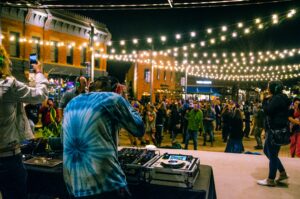
Dallas leans cosmopolitan, fashion-forward, and corporate, a different market entirely from Fort Worth’s Western-heritage identity. Deep Ellum’s gallery and music scene reflects exactly that: a city that sees itself as an arts-and-culture destination first, with a downtown skyline and corporate presence that shapes expectations for polish and formality even at a casual event.
If you’re planning something in Dallas proper, expect vendors and venues that are used to a buttoned-up, big-city clientele, and price accordingly.
Fort Worth: Western Heritage
Fort Worth wears its Western heritage without apology, and Mayfest proves the scale of it. Held every late April into early May at Trinity Park, Mayfest bills itself, by its own organizers, as the biggest party in Fort Worth, with four days of live music, food, carnival rides, and art vendors, a different flavor of event than anything Deep Ellum represents just 30 miles east.
Fort Worth’s Stock Show & Rodeo, covered below, reinforces the same identity on an even bigger scale, and that heritage shows up in everyday event culture too: barn and ranch venues, Western-themed decor, and a generally more casual, family-oriented event style than Dallas’s corporate polish.
Climate: Spring Tornado Risk and Punishing Summer Heat
DFW’s climate carries two distinct, serious planning constraints, and neither one deserves to get glossed over as “hot Texas weather.”
Spring Tornado Season (April–May)
March through May is the best outdoor window here, with temperatures in the pleasant 65 to 85°F range, but April and May carry real tornado risk since DFW sits in tornado alley. Any spring event contract should include a severe-weather clause as a matter of course: a clear cancellation and rescheduling policy tied specifically to severe weather warnings, which general rain language will not cover.
Worth remembering too: the February 2021 ice storm exposed real regional infrastructure vulnerability, with widespread power outages and impassable roads across the metro, a reminder that severe weather here isn’t limited to spring alone and that a winter event carries its own real risk even outside the peak tornado window.
Summer Heat (June–September)
Summer runs brutal, with temperatures of 98 to 106°F, which limits outdoor events to evenings with real shade in place. A midday summer event without serious heat mitigation is a guest-safety issue.
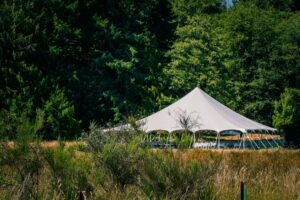
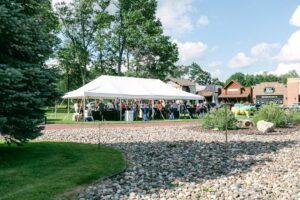
A shade tent over the main gathering space is the difference between an event guests can actually enjoy and one they leave early, and pairing it with real hydration stations matters as much here as the shade itself. If your date is flexible, shifting even a few weeks toward late September buys you noticeably milder conditions while the summer social calendar is still running.
Fort Worth Stock Show & Rodeo (January–February)
Fort Worth’s single biggest scheduling consideration runs January into February: the Stock Show & Rodeo, three-plus weeks of events that drive Western-themed event demand across the entire metro, well beyond the fairgrounds themselves. The event draws visitors from across the region and beyond, and its effect on hotel occupancy and vendor availability extends well past the fairgrounds into greater Fort Worth and even parts of Dallas.
If your date falls anywhere near this window, book well ahead of when you normally would, and confirm early with any Western-themed vendor (linens, decor, catering) whether they’re already committed to Stock Show contracts for that stretch.
DFW’s Scale and Corporate Base
It’s worth naming plainly just how large this metro actually is: DFW runs around 8.3 million people, the fourth-largest metro in the country, and it carries a real, major corporate base to match, anchored by companies like AT&T, American Airlines, Toyota, and Lockheed Martin. That combination of scale and corporate density is exactly why DFW supports two fully separate event economies under one metro name, where a smaller metro would have one.
A planner used to a mid-size city’s single event calendar should expect DFW to behave more like two adjacent cities that happen to share an airport than one cohesive market, with separate peak seasons, separate vendor pools, and separate price tiers depending on which side of the metro you’re booking in.
Dallas’s Charity Gala Culture and Park Cities
Dallas supports a high-end event market that’s worth understanding as a real market structure. Highland Park and University Park, known together as Park Cities, form the highest-tier event market in Texas, with a concentration of wealth and event infrastructure that few other Texas markets can match.
Dallas’s charity-gala culture, from Junior League events to hospital-foundation galas, is elaborate and well-established here in a way that’s distinct from a standard corporate event elsewhere: full-service catering, formal attire expectations, and live or silent auction components are standard at this tier.
If you’re planning something in this tier, our guide to planning Dallas corporate events goes deeper into what that actually looks like, including what separates a Park Cities-caliber budget from a standard Dallas-area corporate event.
How Far Ahead to Book Around DFW’s Calendar
Outside DFW’s peak windows, a typical lead time works fine. Inside them, plan much further ahead, especially in spring.
January and February bring the Stock Show, March through May stacks tornado-season buffer time on top of Mayfest and Deep Ellum, and September through November brings fall wedding and corporate season as temperatures finally cool back down. December rounds it out with major holiday-party demand across both cities’ corporate calendars.
Because DFW effectively runs two separate event economies under one metro name, it’s worth checking demand specifically for whichever city you’re booking in, since one city’s calendar tells you nothing about the other’s availability. Our seasonal event planning guide for Dallas walks through this calendar in more detail if you want to plan multiple events across the year.
Permits and Regulations in Dallas-Ft. Worth
Which permits you need depends on where your event is held, and Dallas and Fort Worth are two separate cities, so the address decides who you’re asking. Start with the property itself: the venue, or the office that manages the site, can tell you what applies to your date and your setup. If you’re serving alcohol at a public event, plan on a temporary state permit alongside anything local.

Venues in Dallas-Fort Worth
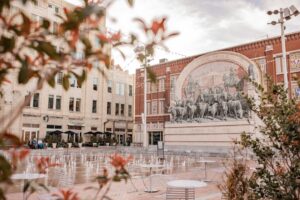
Fort Worth’s Stock Show grounds and Cowtown Coliseum lean fully into the city’s Western identity, while Sundance Square gives Fort Worth a more polished downtown option without losing that same regional character.
Dallas’s Deep Ellum and Uptown arts districts offer a completely different, urban-gallery feel that suits a more contemporary event, and Klyde Warren Park adds a real central downtown-Dallas green space, though it requires its own permit given how heavily used it already is. For something more traditional, country club venues across Highland Park, University Park, and Preston Hollow sit at the high end, catering to the charity-gala and formal-wedding crowd covered above.
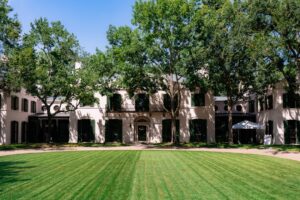
If you’d rather head to the outskirts, the Grapevine vineyard area gives you a wine-country feel without leaving the metro, and farm and ranch venues across Collin, Denton, and Parker Counties offer a rustic option that leans into Fort Worth’s Western identity from a quieter, more rural setting.
For a closer look at the full range, see our guide to Dallas event venues.
Need Party Rentals in Dallas?
Treat Dallas and Fort Worth as the two distinct markets they are, plan around spring tornado risk and summer heat, and give the Stock Show its own lead time if your date falls nearby. Browse linens, tents, and decor party rentals on Reventals to start pulling together the rest of your DFW event.