







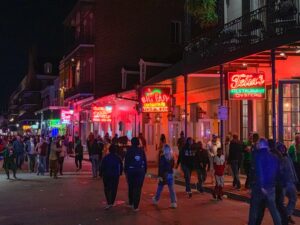



How much do party rentals cost in New Orleans? Let’s make the budget the easy part. We’ll go over typical rental prices, and you can use our free calculator to estimate costs from your guest count.
We’ll also cover how the January-to-May festival season and year-round bachelorette weekends move demand, what hurricane season means for your backup plan, and how delivery works on narrow historic streets.
With real numbers and a little lead time, you’ll be ready to throw a New Orleans celebration your guests still talk about next Carnival.
- Estimate What Your New Orleans Event Will Cost
- How much does it cost to rent tables in New Orleans?
- How much does it cost to rent chairs in New Orleans?
- How much does it cost to rent linens in New Orleans?
- How much does it cost to rent bar and glassware in New Orleans?
- How much does it cost to rent lounge furniture in New Orleans?
- How much does it cost to rent decor in New Orleans?
- What Else You Need to Know About Planning an Event in New Orleans
- Venues in New Orleans
- Need Party Rentals in New Orleans?
Estimate What Your New Orleans Event Will Cost
Put in your guest count, then adjust the item list until it matches what you are renting.
Calculate Approximately How Much Party Rentals Will Cost
Estimate what rentals might cost for your event. We've filled in the basics — add or remove items to see what changes.
Estimated rental cost
—
Rentals only — delivery, setup and damage waiver are quoted separately.
Why a range? Picking your table and chair styles below narrows it. The rest of the spread comes from the other categories — the low end assumes a practical setup, the high end a more formal one.
What's included
Tick anything on or off. Open a row to see what's behind the number.
Real prices depend on your dates and what's available.
See rentalsDelivery and setup. Not included above. Budget roughly $150 to $200 for delivery in most metro areas, and more if the site sits well outside the metro or the load-in needs extra labor — walk-ups, freight elevators and after-hours windows all add time.
Damage waiver.
Totals cover rentals only — not venue, food or staffing.
How much does it cost to rent tables in New Orleans?
A 60-inch round seats 8 with formal place settings, or 10 at a casual buffet where people are up and moving, so 100 guests works out to 10 to 13 tables. Long rectangles seat 8 to 10 each, and platters pass more easily down a long one. A 6-foot rectangle seats 6 to 8 and an 8-foot seats 8 to 10, so a room laid out in 6-footers needs a few more tables than the same room in 8s.
For a reception with no meal served, plan cocktail tables at 1 for every 4 or 5 guests. Put a seated dinner in the middle of the night and the number drops to 1 per 10 guests, since most of the room will be off its feet within the hour.
Add the tables that hold the food, the cake, and the gifts on top of all of that.
New Orleans table pricing looks like this:
Tables
| Item | Typical day rate |
|---|---|
| Specialty & Picnic Tables | ~$15 |
| Cocktail Tables | ~$9 |
| Rectangular Tables | ~$9 |
| Round Tables | ~$9 |
How much does it cost to rent chairs in New Orleans?
Order 1 per guest, counting the people you expect to be on their feet most of the night. Add 2 or 3 past your headcount to cover the head table and any late yes.
Then think about how long anyone is sitting in one, since that is what the style comes down to:
- Poly folding chairs. Light, stackable and unpadded. That is what makes a fast flip possible, so a team of people can reset a room quickly while guests socialize. Folding chairs are a practical, budget-friendly option for casual events.
- Chiavari and luxury chairs. The formal choice, in gold, silver, white, black or wood. They arrive finished, so you can leave covers and sashes off the order. These are padded, so they’re more comfortable for formal, seated dinners.
Here’s what chairs run around New Orleans:
Chairs
| Item | Typical day rate |
|---|---|
| Barstools | ~$11 |
| Benches & Other Chairs | ~$10 |
| Luxury & Chiavari Chairs | ~$9 |
| Folding Chairs | ~$3 |
How much does it cost to rent linens in New Orleans?
Plan 1 per table, plus a napkin per guest for a seated meal.
Sizes go by the table. A 4-foot banquet table takes an 82 by 106 cloth to reach the floor, or a 60 by 96 for a lap drop. A 36-inch round, which seats 4, takes a 90 to the floor and a 72 at lap height. No formula gets you from a table size to a cloth size, so match every table off a sizing chart before you place the order.
Chair covers tie mismatched seating together in 1 color, and they’re the fastest way to make a set that came from 2 places look like 1 set.
Typical linen rates in the New Orleans area:
Linens
| Item | Typical day rate |
|---|---|
| Round Linens | ~$15 |
| Rectangular Linens | ~$10 |
| Square Linens | ~$9 |
| Chair Covers & Accessories | ~$3 |
| Napkins | ~$0.75 |
How much does it cost to rent bar and glassware in New Orleans?
Start with the room, and get the venue’s list of what it already stocks.
Then count glasses by what you’re pouring. If there’s a toast, that’s 1 champagne flute per guest, and it’s a glass that gets used once and then sits, so it’s counted on its own and not folded into the rest of the bar.
Draft beer needs glassware while bottles and cans may not, so a beer list that’s all cans takes those glasses out of the count. If you’d sooner order 1 shape than keep track of 4, rocks glasses cover the most ground.
What bar and glassware cost around New Orleans:
Bar and glassware
| Item | Typical day rate |
|---|---|
| Bars | ~$300 |
| Wine & Champagne Glasses | ~$0.85 |
| Specialty Glasses | ~$0.75 |

How much does it cost to rent lounge furniture in New Orleans?
Plan roughly 1 grouping per 100 guests, and put it where people will drift when they step away from the food and the music. Point the seating inward around 1 low table, and set the whole thing back from the speakers so a conversation is possible there.
Cocktail-style events fill this city’s calendar, from bachelorette weekends to conventions at the Ernest N. Morial Convention Center, and those are the nights guests appreciate a comfortable corner to sit down in. At 200 guests that’s 2 groupings, and spreading them to opposite ends of the room beats parking both in 1 corner. Renting lounge furniture gives your guests a comfortable place to settle in away from the crowd.
New Orleans pricing for lounge pieces:
Furniture
| Item | Typical day rate |
|---|---|
| Sofas & Settees | ~$150 |
| Coffee Tables & Side Tables | ~$40 |
How much does it cost to rent decor in New Orleans?
Drape and stanchions are both there to shape a room you’ve already booked. Drape brings an oversized space down to the size of your guest list, or screens off a service area so the room reads as 1 finished space. It also gives you a plain backdrop for photos in a room that doesn’t have one.
Stanchions organize the flow at a door or a bar and keep a clear path across a busy floor.
Walk the room first and note the walls you want covered, and the doors you’d sooner guests didn’t use.
Here’s what decor runs in the New Orleans area:
Decor
| Item | Typical day rate |
|---|---|
| Stanchions | ~$25 |
| Pipe & Drape | ~$15 |

What Else You Need to Know About Planning an Event in New Orleans
New Orleans’ Festival Season Runs January Through May
New Orleans doesn’t have a handful of scattered festival dates to check off. It has one continuous season, running from early January through early May, during which three major events cascade one after another. Treat this whole stretch as elevated demand, not three separate dates to plan around individually.
Here’s the shape of it, so you can spot where your date falls: Carnival season opens the year in January and runs into February or March, depending on when Easter lands; French Quarter Festival picks up in early April right after Carnival winds down, and Jazz Fest closes out the season in late April into early May. There’s barely a gap among the three, which is exactly why vendors and venues stay busy for the entire stretch, including the weekdays in between.
Mardi Gras / Carnival Season (January–February or March)
Carnival season is longer than most visitors expect. It begins on Twelfth Night, January 6, and runs through Mardi Gras Day itself, the day before Ash Wednesday, drawing hundreds of thousands of visitors for parades and Carnival traditions along the way.
A lot of that demand comes from krewe culture. Krewes, the social organizations behind Mardi Gras parades, also host private balls, dinners, and other events throughout the season, and those events compete for the same caterers, florists, and venues your event needs. An experienced local planner books well outside the core Carnival weeks if at all possible, or locks in a venue and vendor team a full year ahead if the date has to fall inside the season. If your event has any flexibility at all, late spring after Mardi Gras clears the calendar considerably.
Bachelorette and Bachelor Party Tourism: A Year-Round Demand Driver
New Orleans is one of the top bachelorette destinations in the country, and that demand doesn’t wait for a festival. Groups travel here from across the country year-round, creating a steady baseline of demand that differs structurally from the festival spikes above.
That matters for how you plan. The festival calendar creates predictable surges you can plan around and, in some cases, avoid. Bachelorette demand doesn’t work that way. Because it’s constant instead of seasonal, there’s no reliably slow month where you can count on easy vendor availability just because no festival is happening. A planner organizing an event here should still book early even in a supposedly quiet month, and should expect popular bars, restaurants, and party venues to run busy most weekends regardless of the season.
If you’re the one planning the trip, build your weekend around a home base and skip trying to cover the whole city. Most groups anchor around the French Quarter or Marigny/Bywater and walk to everything from there, since a walkable itinerary avoids the added cost and hassle of coordinating rideshares for a large group late at night. Multi-night stays are the norm here, not a single big evening, so pace your group’s budget and energy across the full weekend instead of front-loading it all into one night out.
Weather and Hurricane Season in New Orleans
New Orleans’ climate shapes both when you should schedule an outdoor event and how much you should budget for backup coverage if things go wrong.
The Comfortable Season (October–April)
October through April is New Orleans’ best outdoor season, and it overlaps with, but isn’t identical to, the festival calendar above. Mardi Gras season lands right in the middle of the most pleasant weather of the year, which is part of why it draws such a crowd.
Summer runs from June through September and brings brutal heat and humidity. Outdoor events during these months are best scheduled for evening or night, once direct sun and peak heat have passed. If your date is locked into summer, plan around the sun, not against it.
Hurricane Season, Flood Risk, and Insurance (June–November)
Hurricane season runs June through November, and the risk here is real, not theoretical. Katrina and Ida are both part of this city’s recent history, and flood risk is an ongoing concern beyond named storms alone.
The honest, practical response to that risk is the same one any coastal city should give: have a firm backup plan, whether that’s a flexible reschedule date or a backup indoor venue, and budget for adequate event insurance given the weather risk here. Event insurance requirements in New Orleans tend to run higher than in most cities, so build that into your budget from the start. If a storm is bearing down on your date, the right move is to reschedule or move indoors, not to look for specialized storm-rated equipment as a workaround.
Peak hurricane activity along the Gulf typically clusters in August, September, and October, so an event booked in those months carries the most real risk inside an already-wide June-through-November window. That doesn’t mean avoid those months entirely; it means build your contingency plan when you book, not when a storm shows up in the ten-day forecast.
Delivery and Setup Access in New Orleans’ Historic Neighborhoods
The Garden District, Marigny, Bywater, and the streets around the French Quarter’s edges share a real physical constraint: narrow streets, limited on-street parking, and older buildings that weren’t designed with modern delivery trucks in mind. A rental delivery that would take 15 minutes at a purpose-built event venue can take considerably longer here.
Some historic properties only offer courtyard access or have no dedicated loading alley at all, which means tents, tables, and chairs may need to be hand-carried in, with no truck rolling up to the door. Street parking near these venues is often limited to a handful of spots, and some blocks restrict truck loading to specific morning hours to keep traffic moving during the day.
New Orleans’ Quieter Months for Booking
Once you account for Carnival season, Halloween in October, Jazz Fest in April and May, and Thanksgiving and year-end corporate events in November, New Orleans doesn’t have much true dead time left on its calendar.
Summer, June through September, is the closest thing to a lower-demand window. Even then, it’s not a true off-season the way it might be in a city without New Orleans’ year-round bachelorette traffic; that baseline demand keeps some vendors and venues busy regardless of the month.
Permits and Regulations in New Orleans
Whether your event needs a permit here comes down to where it is held and what it involves. The city runs an event-permit process, so ask your venue which approvals it already holds and which ones fall to you.
If a tent or a street procession is part of the plan, put the same question to your rental vendor. Having that answer while your layout can still move is worth more than any fee you will look up later.
Venues in New Orleans
Most visitors assume the French Quarter is where private events happen in New Orleans. The opposite is closer to the truth: the Quarter is restrictive for private events, and the real local event scene lives just outside it, in the Garden District, Marigny, Bywater, and Mid-City.
These neighborhoods offer private mansion venues, walled courtyard spaces, and neighborhood event halls with far more flexibility than anything you’ll find on Bourbon Street. The Garden District leans toward historic, formal architecture, well suited to a wedding or milestone celebration; Marigny and Bywater run more relaxed and artsy, a good fit for a birthday party or casual gathering, with the right chairs and tables to set the scene; Mid-City offers a middle ground between the two, closer to City Park and easier to reach from most of the metro.
Check out our venue roundups for New Orleans:

Need Party Rentals in New Orleans?
New Orleans plans differently than most cities: a five-month festival season, year-round bachelorette demand, real hurricane-season stakes, and historic neighborhoods with their own delivery logistics. From there, explore rental options near you on Reventals and start planning today to bring the rest of your New Orleans event together.
Whether you need tents for an outdoor courtyard setup, chairs and tables for a seated dinner, or bars to keep the drinks flowing, you’ll find trusted local vendors on Reventals ready to deliver.