



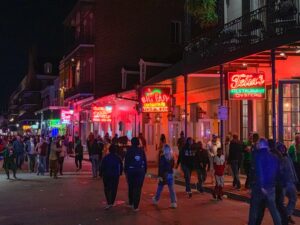

If you’re planning an event in Lafayette, there are some real seasonal conditions you’ll want to plan around: Mardi Gras in January and February, crawfish-boil season through the spring, and Festival International de Louisiane’s five days in April.
If you plan your Lafayette event around festival season, you’ll avoid the scramble that happens when a date lands on top of one of these peak weeks by accident.
This guide covers the weather and pest realities, the cultural expectations that shape a Cajun event, and how far ahead to book in this city.
- Weather, Hurricanes, and Mosquitoes
- Lafayette’s Festival Calendar
- Cajun Culture Shapes Every Event
- Venues in Lafayette
- How Far Ahead to Book in Lafayette
- Permits and Regulations in Lafayette
- Need Party Rentals in Lafayette?
Weather, Hurricanes, and Mosquitoes
Lafayette’s subtropical climate and hurricane risk shape when to schedule an outdoor event here, and the region’s mosquitoes are worth planning around, too. Here’s what each one means for your date.
Heat, Humidity, and Hurricane Season
October through April is Lafayette’s biggest event season. But fall, specifically October through November, is the most reliable stretch because of the warm but manageable days in the 75–85°F range. Winter stays mild too, usually 55 to 70°F, with only an occasional cold snap and rare light frost between December and February. Spring, February through April, is excellent as well, and it happens to be the same window that the Mardi Gras season falls into. Basically, there’s a ton of wiggle room in this city if you want to host an outdoor event!
But Summer is a different story. May through September brings a heat index of 100 to 110°F along with oppressive humidity, which makes an all-day outdoor event a hard sell for guests. If your date is locked into summer, push the event to the evening and build in shade and water wherever people will actually be standing.
Hurricane season runs June through November, covering half the year, and it’s a real risk here. Hurricane Ida in 2021 was devastating to the region, and that’s the scale you should take seriously when you pick a date in this window. Have a firm indoor backup venue or a clear rescheduling policy built into your plans if you’re planning this season.
Mosquitoes: A Real Planning Consideration
A few small setup choices make a real difference here. Put a repellent station near the entrance, ring the perimeter with citronella candles or torches, and consider a misting system if the event runs into the evening or sits near water, which covers a lot of ground in bayou-adjacent Lafayette. If you’re renting outdoor lighting for an evening event anyway, choose warm-toned string lights over bright white ones. Bright white light pulls in more bugs, and warm lighting looks better in photos.

Lafayette’s Festival Calendar
Two major events reshape Lafayette’s calendar every year. Check your date against both before you book anything.
Mardi Gras Season (January–February)
Mardi Gras season runs January through February, and Cajun-country Mardi Gras looks different from the French Quarter parades most people picture. Rural traditions, like the courir de Mardi Gras, where costumed riders travel house to house collecting ingredients for a communal gumbo, are still very much part of the season in and around Lafayette, alongside the more familiar downtown parades. The timing also works in your favor: this window sits right in the middle of the region’s best spring weather, so a Mardi Gras-adjacent event doesn’t fight the climate the way a summer date would.
Festival International de Louisiane (April)
Festival International de Louisiane takes over downtown Lafayette for five days every April, April 22–26 in 2026, and draws more than 300,000 people, making it the largest non-ticketed outdoor Francophone festival in the country. Admission is free, which is part of why it pulls such a massive crowd from across the region and beyond.
If your event falls anywhere near this week, expect real scarcity on downtown venues, catering, and rental equipment. Vendors who have plenty of open dates in March or June can be booked solid by the time Festival International rolls around, so lock in anything downtown well before the calendar gets close.

Cajun Culture Shapes Every Event
Beyond the dated festivals above, a handful of year-round cultural practices shape how an ordinary Lafayette event gets planned, whether or not it has anything to do with Mardi Gras or Festival International.
Crawfish Boil Season (February–May)
Crawfish boils run from February through May and count as the signature social event of Cajun culture, not just a meal on the calendar. A real boil calls for a different rental setup than a standard party: long tables built for cracking shells and piling up newspaper-lined crawfish, plenty of outdoor seating, and a communal layout where people eat standing up and moving around as much as sitting down. Renting extra tables and chairs to handle a communal, come-and-go crowd is usually the easiest way to cover a guest list that never sits down all at once.
Live Music Is Non-Negotiable
A live Zydeco or Cajun band is the default at most Lafayette events, not a DJ-and-speaker setup. That expectation carries a real logistics need that most planners from outside the region wouldn’t think to ask about: bands need real power. If your venue doesn’t already have adequate electrical service, budget for a generator or confirm power access well before the event, since a band that can’t plug in isn’t much of a band.
The Catholic Church Calendar
Lafayette is heavily Catholic, and the church calendar shapes event timing more than planners from other regions might expect. Lent brings real restrictions on some kinds of celebrations and food, so double-check your date if it falls in that window. Spring also brings a wave of First Communion parties and parish fairs that compete for the same weekends as everything else on this list, so check the parish calendar for your date if you’re planning anything from February through April.
Venues in Lafayette
Lafayette’s venue scene is smaller than Houston’s or New Orleans’, and that’s a real feature of this market, not a gap in our research. Vermilionville, a living history museum along the Bayou Vermilion, rents out its grounds for events that want a real Cajun and Creole atmosphere without much extra styling. Girard Park offers a straightforward, budget-friendly outdoor option for a family gathering or reunion.
Beyond these three, expect to see more private homes with big yards than a typical big-city event scene offers. Cajun event culture leans on the backyard as a default venue, and a lot of Lafayette’s best gatherings happen there instead of at a rented hall.
If you’re looking to host a private-home event, treat the same festival and crawfish season windows above as your booking calendar for tables, chairs, and catering, too, since a backyard doesn’t come with built-in seating or shelter the way a hall does.

How Far Ahead to Book in Lafayette
Lafayette runs three overlapping demand windows back-to-back, which makes the lead time here different from that in many other markets. Mardi Gras season (January–February) flows straight into crawfish season (February–May), and Festival International de Louisiane’s five-day week lands right in the middle of that overlap every April. From January through April, expect real competition for venues, caterers, and rental equipment, and book several months in advance if your date falls within that stretch.
May is worth watching, too. Crawfish season technically runs through May, and the last big boils before summer heat sets in still pull on the same vendor pool, even though the spring rush has technically ended by then.
Outside of January through May, a normal lead time works fine for most vendors and venues in Lafayette. It’s really this one long stretch that needs the extra runway.

Permits and Regulations in Lafayette
Most Lafayette events never touch a permit office at all. But if you’re planning something on public property, serving alcohol, pitching a large tent, or running live music past standard quiet hours, here’s who to check with and why.
Lafayette Consolidated Government Special Event Permits
If your event is happening in a public park or on a public right-of-way, Lafayette Consolidated Government requires a Special Event Permit. The application goes through the Parks, Arts, Recreation & Culture / Development & Planning department, and it’s posted at lafayettela.gov/DP/anc/special-event-permit. Expect a $125 fee for a standard event, or $50 if you’re a verified 501(c)(3) nonprofit.
The department accepts applications as little as 5 days out, but recommends 15 days ahead, so build that lead time into your planning if a public park is your venue. You’ll also need a signed letter of permission if you don’t own the property, and some public events require pre-approved law-enforcement security. The good news: if you’re booking a private venue, a hall, or a rented event space, this process typically doesn’t apply. Worth confirming with your venue up front whether the space is public or private.
Alcohol Permits for Events (Louisiana ATC)
Planning to serve alcohol at a public or ticketed event? The Louisiana Office of Alcohol and Tobacco Control issues a temporary special-event permit valid for up to three consecutive days. There are three types, depending on who’s applying: Type A is free for 501(c)(3)/(c)(8) nonprofits; Type B covers other nonprofits with proof of charitable purpose; and Type C applies to everyone else who meets standard Louisiana permit-holder qualifications.
Submit your application at least 10 days before the event, along with your local special-event permit (or written local authorization) and proof of property access. Note that a person or organization can pull a maximum of 12 of these permits per calendar year. A private home crawfish boil doesn’t need one of these, but a ticketed festival-adjacent event or a public-park gathering serving alcohol does. Confirm with your venue whether their existing liquor license already covers the event before you assume you need a separate ATC permit.
Tent and Structure Permits
Lafayette’s fire prevention office, part of the Lafayette Fire Department, issues permits for tents and membrane structures under the state fire code, with the application posted at lafayettela.gov. Louisiana generally follows International Fire Code thresholds for when a tent needs a permit, commonly 400 square feet in jurisdictions using the same code edition, but we haven’t independently confirmed that exact number as Lafayette’s own current rule. If you’re renting a large tent, ask the rental company or your venue directly whether a permit is required for the specific size you’re getting; don’t assume a small residential tent and a big event tent are treated the same way. Get that squared away before the week of the event, not during it.
Noise Ordinance and Event Variances
Lafayette’s noise ordinance sets quiet hours of 10 pm to 7 am on weekdays and 10 pm to 9 am on weekends and federal holidays, with residential sound limits of 60 dB(A) during the day and 50 dB(A) at night. That matters directly for the live-music expectation covered above: an evening event with a band running past 10 pm on a weeknight either needs an approved variance or a plan to wrap the amplified set by the standard cutoff.
Need Party Rentals in Lafayette?
Lafayette’s calendar runs on real seasons: Mardi Gras, crawfish boils, and Festival International de Louisiane, all stacked close together every spring. Plan around them, account for the heat and mosquitoes the rest of the year, and give yourself extra lead time in a smaller market where word-of-mouth still matters. Browse party rentals on Reventals to start planning your event in Lafayette. You’ll find everything from tents and lighting to chairs and generators, all ready to be delivered across Lafayette Parish.