









Horseshoes is a classic backyard game that’s easy to learn and perfect for parties, family gatherings, and outdoor events. If you’re wondering how to play horseshoes, you’re in the right place.
With just a few simple rules and minimal setup, this game can quickly become a guest favorite. Whether you’re planning a casual get-together or a larger event, horseshoes is a fun, low-effort way to keep everyone entertained.
- What You Need to Play Horseshoes
- How to Set Up a Horseshoe Game
- How to Play Horseshoes
- Types of Throws in Horseshoes
- Horseshoes Scoring Breakdown
- How to Throw Horseshoes (Simple Techniques That Work)
- Tips for Adding Horseshoes to Events
- Where to Rent a Horseshoes Game
What You Need to Play Horseshoes
Before jumping into how to play, it helps to have the right setup. The good news is that Horseshoes is a low-effort game that requires minimal equipment and space, making it perfect for casual gatherings or larger outdoor events.
Horseshoes Equipment Checklist
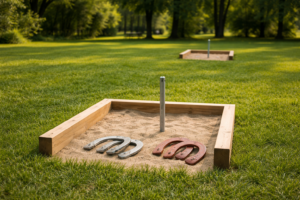
- 2 stakes (metal or plastic)
- 4 horseshoes (2 per player or team)
- A flat playing area (grass, sand, or dirt works best)
If you don’t already have a set, renting horseshoes can be an easy way to get everything you need without worrying about setup or storage. Many event rentals include ready-to-play sets, making it simple to add a classic lawn game to your next gathering.
How to Set Up a Horseshoe Game
Setting up a horseshoe game is quick and straightforward. Follow these simple steps to get started:
1. Place the Stakes
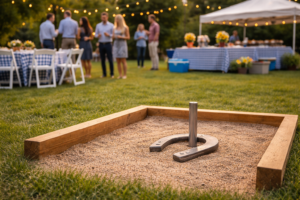
- Set two stakes 40 feet apart (standard distance)
- Drive each stake into the ground so it stands 14–15 inches high
- Angle the stakes slightly toward each other
2. Create a Throwing Area
- Make sure there’s clear space around each stake
- Players will stand near the stake when throwing
- Optional: mark a small “pitching box” for consistency
3. Adjust for Casual Play
- Shorten the distance to 20–30 feet for beginners or kids
- Use grass, dirt, or sand; no official court is required
How to Play Horseshoes
Horseshoes is simple to learn and easy for guests of all ages to enjoy. Here’s how to play:
- Choose your players or teams. You can play one-on-one or with two teams of two.
- Give each player or team two horseshoes.
- Stand at one stake and take turns throwing. Each player throws both horseshoes toward the opposite stake.
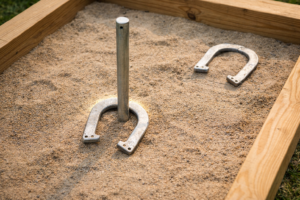
- Aim to get your horseshoes as close to the stake as possible. The best throw is a ringer, which wraps around the stake.
- Let the other player or team throw from the same end. Once everyone has taken a turn, that round is complete. Walk to the opposite stake and repeat.
- Players continue throwing from alternating ends of the court.
- Keep playing until someone reaches the winning score.
Casual games are played to 21 points.
Types of Throws in Horseshoes
Before keeping score, it helps to understand the main types of throws:
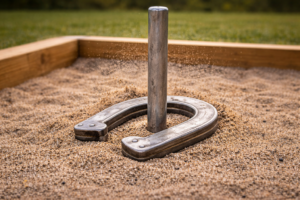
- Ringer: the horseshoe lands around the stake (the best possible throw)
- Leaner: the horseshoe is touching and leaning against the stake
- Closest: the horseshoe that lands closest to the stake when no ringers are thrown
Once you know these, scoring becomes really simple.
Horseshoes Scoring Breakdown (Simple & Easy)
Scoring in horseshoes is based on who had the better throws in that round, not both players adding up points. This means that after both players throw their horseshoes, you compare all the throws. The best throw wins the round, and the other player’s throws are canceled out.
Here’s how scoring works in simple terms:
- Ringers are worth 3 points.
- If there are no ringers, the closest horseshoe gets 1 point.
- Only one player scores per round. The best throw cancels out the other player’s.
- First to 21 points wins.
Example Round
- You throw 1 ringer (3 points)
- Your opponent throws 1 closest (1 point)
- Your better throw cancels theirs → you score 2 points
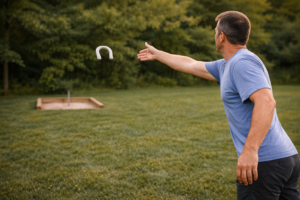
How To Throw Horseshoes (Simple Technique That Works)
Most beginners miss because they try to “aim harder.” Good players focus on consistency, not power.
Tips for Adding Horseshoes to Events
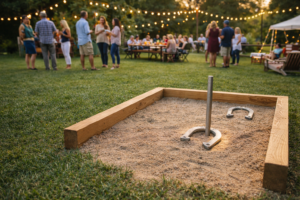
Horseshoes are easy to add to almost any outdoor event and work best when guests have a casual space to play and hang out in.
Best Types of Events
- Backyard parties
- Weddings (especially cocktail hour or outdoor lounge areas)
- Family reunions
- Corporate events and team-building days
- BBQs, birthdays, and holiday gatherings
Where to Set It Up
- Open grassy areas
- Backyard corners or side yards
- A designated “lawn game zone”
- Near seating areas so guests can watch and join in
Pro Tips for Events
Set it up off to the side to avoid heavy foot traffic, and consider pairing the horseshoe game with other games like cornhole or ladder golf.
You can also add chairs or benches nearby to create a social space.
Where to Rent a Horseshoes Game
Horseshoes is a simple, classic game that’s easy to learn and fun for all ages. With minimal setup and straightforward rules, it’s a great addition to everything from casual backyard hangouts to larger events.
If you’re planning a party or event, adding horseshoes is an easy way to keep guests entertained without a lot of extra effort. To make things even easier, you can browse Reventals and rent horseshoes (along with other lawn games) all in one place.
Other Blogs You May Find Helpful:
FAQ’s
What are the basic rules of horseshoes?
Players take turns throwing horseshoes at a stake in the ground. Points are scored based on how close the horseshoe lands to the stake. The game typically continues until a player or team reaches a set score, often 21.
How do you play horseshoes?
Each player throws two horseshoes per turn toward the opposite stake. Players alternate turns, and scoring is based on proximity or if the horseshoe encircles the stake (called a ringer).
How do you keep score in horseshoes?
Points are awarded as follows:
-
Ringer (encircles the stake): 3 points
-
Leaner (touching the stake): 1 point
-
Closest horseshoe: 1 point
Only one player or team scores per round.
What is the purpose of horseshoes as a game?
The goal is to score points by landing horseshoes as close as possible to the stake or by throwing ringers. It’s a skill-based game that combines accuracy and consistency.
How many horseshoes do you need to play?
You need four horseshoes total, two for each player or team, and two stakes set in the ground.
How many horseshoes does each player use?
Each player uses two horseshoes per turn.
How many horseshoes are used in a full game?
A standard game uses four horseshoes total, regardless of the number of players.
What score do you play to in horseshoes?
Most games are played to 21 points, but some casual games may use 15 or 40 depending on preference.
What are the official rules for playing horseshoes?
Official rules (like those from the National Horseshoe Pitchers Association) include:
-
Stakes placed 40 feet apart (for adults)
-
Players must stay within the pitching box
-
Games are typically played to 40 points in sanctioned play
Where can I play horseshoes near me?
You can often find horseshoe pits at parks, campgrounds, event venues, and backyard party setups. Many event rental companies also offer portable horseshoe sets.
What do you play to in horseshoes?
Most casual games are played to 21 points, while tournament play may go to 40 points.