










Looking for kickball instructions for your next company picnic, field day, church event, or fundraiser?
Kickball is an easy-to-learn game that combines the rules of baseball with the simplicity of kicking a ball, making it a favorite for players of all ages. In this guide, you’ll learn how to play kickball, including kickball rules, field setup, scoring, and gameplay basics.
Plus, download our free printable kickball rules sheet to make organizing your event even easier.
- How to Play Kickball – Quick Breakdown
- Equipment Needed to Play Kickball
- How Much Space Do You Need for Kickball?
- Kickball Field Setup
- How Players Get “Out” in Kickball
- How to Play Kickball (Step-by-Step)
- Defensive Positions in Kickball
- Common Kickball Rules
- Where to Rent Kickball for Events
- FAQ’s About Kickball
How to Play Kickball – Quick Breakdown
Need a quick overview before your event? Here are the basic kickball rules:
- Divide players into two teams.
- Set up four bases in a diamond shape, similar to a baseball field.
- One team kicks while the other defends.
- The pitcher rolls the ball toward home plate, and the kicker attempts to kick it into the field.
- After kicking, the player runs the bases in order and tries to return to home plate to score a run.
- Defensive players record outs by catching kicked balls, tagging runners with the ball, or forcing runners out at a base.
- Each team bats until three outs are recorded.
- After three outs, the teams switch roles.
- The team with the most runs at the end of the game wins.
Equipment Needed to Play Kickball
One reason kickball is such a popular choice for company picnics, field days, church events, and fundraisers is that it requires very little equipment to get started.
Essential Equipment
- 1 kickball
- 4 bases (or cones)
- Open playing field
- At least 8–10 players
If you rent a kickball setup, it should come with all the basics you need to play.
Optional Equipment
- Additional cones to mark boundaries
- Scoreboard or score sheets
- Team jerseys or colored shirts
- Water station for players
- First aid kit

How Much Space Do You Need for Kickball?
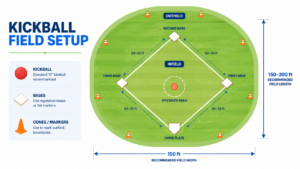
A standard kickball field uses a baseball or softball-style diamond with bases approximately 50–70 feet apart. For most casual games, a grassy area measuring roughly 150–200 feet long and 150 feet wide provides plenty of room for gameplay.
To put that into perspective, you’ll want a space about the size of a youth soccer field, two basketball courts placed side-by-side, or a typical baseball outfield.
If you’re organizing a larger event, consider using a baseball field, softball field, school athletic field, or community park. Many local parks allow groups to reserve fields in advance, which can help ensure you have enough space and avoid conflicts with other activities on the day of your event.
Before your event, check with your local parks and recreation department to see whether reservations are required and whether any permits or fees apply.
Kickball Field Setup
Before the game begins, you’ll need to set up a kickball field. The layout is similar to a baseball or softball field, making it easy to use existing athletic fields or open grassy areas.
Set Up the Bases
Place four bases in a diamond shape:
- Home plate, where players kick the ball
- First base
- Second base
- Third base
For most recreational games, position the bases approximately 50–70 feet apart. If you’re playing with younger children, you may want to shorten the distance between bases.
Position the Pitcher
The pitcher stands near the center of the diamond and rolls the ball toward home plate for each kicker. Unlike baseball, kickball pitches are typically rolled along the ground rather than thrown through the air.
Establish Field Boundaries
Use cones or field markers to define the outfield boundaries if you’re playing in an open area. Adjust the size of the field based on the number of players and the available space.
Kickball Field Diagram
How to Play Kickball (Step-by-Step)
Once your field is set up and teams are chosen, it’s time to start playing. Kickball follows many of the same principles as baseball, but the rules are simple enough for players of all ages to learn in just a few minutes. Follow the steps below to understand how a typical kickball game is played.
Step 1: Divide Into Two Teams
Start by dividing players into two teams of roughly equal size. While kickball can be played with as few as 4–5 players per team, most games work best with 8–11 players on each side.
If you’re organizing a company picnic, church event, or field day, don’t worry about creating perfectly balanced teams. The goal is to keep the game fun and inclusive. Consider mixing ages, skill levels, or departments to encourage teamwork and friendly competition.
Once teams are selected, choose one team to kick first and the other team to take the field on defense.
Step 2: Choose Which Team Kicks First
Before the game begins, decide which team will kick first and which team will take the field on defense. The easiest way to do this is with a coin toss, rock-paper-scissors, or another simple random method.
The kicking team lines up near home plate and takes turns kicking the ball. Meanwhile, the defensive team spreads out across the infield and outfield, with one player serving as the pitcher.
Once both teams are in position, the pitcher rolls the ball toward home plate to begin the first play.
Step 3: Roll the Ball to the Kicker
The pitcher begins each play by rolling the ball along the ground toward home plate. Unlike baseball, kickball pitches are typically rolled rather than thrown through the air.
As the ball approaches, the kicker attempts to kick it into fair territory and then run to first base. A strong kick can send the ball into the outfield, giving the kicker more time to advance around the bases.
If the kicker misses the ball, the pitch counts as a strike. Many recreational leagues allow three strikes before the kicker is called out, though local rules may vary.
Step 4: Kick the Ball and Run the Bases
After kicking the ball into play, the kicker becomes a runner and heads to first base. If the ball is kicked far enough, the runner may continue to second base, third base, or even all the way home plate.
Runners must touch each base in order:
- First Base
- Second Base
- Third Base
- Home Plate
A runner can stop at any base and wait for the next kicker if advancing would be risky. Staying on a base keeps the runner safe until the next play begins.
Step 5: Record Outs
The defensive team tries to prevent runners from reaching base and scoring runs. In kickball, an out is typically recorded in one of three ways:
- Catching a kicked ball before it touches the ground
- Tagging a runner with the ball while they are not on a base
- Reaching a base with the ball before the runner arrives (force out)
Each out brings the defensive team one step closer to ending the inning. Once three outs have been recorded, the teams switch roles.
Step 6: Switch Sides After Three Outs
Once the defensive team records three outs, the half-inning ends. The teams then switch roles:
- The kicking team takes the field on defense.
- The defensive team moves to the kicking lineup.
This gives both teams an equal opportunity to kick, run the bases, and score runs throughout the game.
Step 7: Score Runs
A run is scored when a player successfully touches first base, second base, third base, and returns to home plate without being called out.
The team continues batting until three outs are recorded, giving multiple players an opportunity to get on base and score. At the end of the game, the team with the most runs wins.
Tip: Encourage runners to pay attention to the ball and communicate with teammates. Smart baserunning often leads to more runs than powerful kicks.
Step 8: Continue Until the Game Ends
Most recreational kickball games are played for 5–7 innings or until a predetermined time limit is reached. This makes it easy to fit a game into a company picnic, field day, church event, or fundraiser schedule.
After both teams have had an equal number of turns kicking, compare the final scores. The team with the most runs wins the game.
If the score is tied and you want a winner, continue playing additional innings until one team finishes an inning with more runs than the other.

How Players Get Out in Kickball
The defensive team records outs to end the kicking team’s turn at bat. Once three outs are recorded, the teams switch sides.
While local rules may vary, most kickball games use the following methods for recording outs:
Catching a Kicked Ball
If a defensive player catches a kicked ball before it touches the ground, the kicker is immediately out.
This is one of the quickest ways to record an out, and it often occurs when a kicker pops the ball high into the air instead of kicking a line drive or a ground ball.
Tagging a Runner
A runner is out if a defensive player tags them with the ball while they are not touching a base.
For example, if a runner is caught between first and second base and a defender tags them with the ball before they reach a base, the runner is out.
A player standing safely on a base cannot be tagged out.
Force Outs
A force out occurs when a runner is required to advance to the next base and a defensive player reaches that base with the ball before the runner arrives.
For example, if a kicker is running to first base, a defender can field the ball and touch first base before the runner gets there to record an out.
Force outs are common at first base and are often easier than tagging a runner.
Can You Throw the Ball at Runners?
It depends on the rules being used for your game.
Some kickball leagues and recreational groups allow defenders to get runners out by throwing the ball at them below the shoulders. If the ball hits the runner before they reach a base, the runner is out.
However, many schools, churches, company picnics, and community events do not allow this rule because of safety concerns. Instead, defenders must tag runners with the ball or record a force out at a base.
If children are participating, we recommend using a no-throw rule. While being hit by a kickball is usually not dangerous, removing this strategy helps reduce the risk of injuries, hurt feelings, and disputes during the game.
Before the game begins, make sure everyone understands which rules will be used so there are no surprises once play starts.

Defensive Positions in Kickball
Once the ball is kicked, the defensive team’s job is simple: get the ball, get runners out, and keep the kicking team from scoring.
Most players will spread out between the infield and outfield. Think of it this way: infielders handle the quick plays, while outfielders chase down the big kicks.
Pitcher: The Game Starter
The pitcher kicks off every play by rolling the ball toward home plate. Once the ball is kicked, they’re no longer just a pitcher, they’re another defender on the field.
Because the pitcher stands near the middle of the action, they’re often the first player to react to short kicks and loose balls. If you’ve got a player who likes being involved in every play, pitcher is a great spot for them.
Infielders: The First Line of Defense
Infielders play closest to the bases and usually see the most action during a game.
Their job is to stop ground balls, catch short kicks, and help record outs before runners reach the next base. When a ball is kicked into the infield, players need to think quickly: Should they tag the runner? Throw to a base? Hold the ball and stop everyone from advancing?
If kickball were a movie, the infielders would be the cast members getting the most screen time.
Outfielders: The Home Run Stoppers
Outfielders play behind the infield and are responsible for tracking down long kicks before they turn into easy runs.
When the ball gets past the infield, the outfielders become the heroes of the play. Their job is to retrieve the ball quickly and throw it back toward the bases so runners can’t keep advancing.
Fair warning: if someone on the kicking team has a powerful leg, your outfielders may get plenty of exercise.

Common Kickball Rules
One of the best things about kickball is that the rules can be adjusted to fit your group. A company picnic may use slightly different rules than a school field day or church event.
Before the game begins, take a few minutes to review any special rules with participants. This helps prevent confusion and keeps the focus on having fun.
Here are some of the most common kickball rules you’ll encounter:
Foul Balls
A foul ball is a kick that lands outside the field of play.
In most games, a ball is considered foul if it:
- Travels outside the baseline before reaching first base
- Travels outside the baseline before reaching third base
- Goes out of bounds as soon as it is kicked
What happens after a foul ball?
- Play stops
- Runners return to their previous bases
- The kicker receives a strike (in most games)
Event Planner Tip: Before the game starts, use cones or field markers to clearly mark the foul lines. This helps players know what’s in bounds and prevents friendly disagreements during the game.
Strikes and Outs
A strike occurs when a kicker:
- Misses the ball while attempting to kick it
- Kicks a foul ball (in most games)
Many recreational kickball games use a three-strike rule, meaning a kicker is out after three strikes.
A kicker can also be called out when:
- A defender catches their kicked ball before it touches the ground
- A defender tags them with the ball (if your game allows pegging)
- A defender records a force out at a base
Event Planner Tip: If you’re playing with younger children or first-time players, consider allowing unlimited pitches before recording strikes. This keeps the game moving and helps everyone participate.
Leading Off and Base Running
Once a player reaches a base, they must wait there until the next ball is kicked into play.
In most recreational kickball games:
- Runners cannot leave a base until the ball is kicked
- Runners must touch each base in order
- Runners can stop at a base and wait for the next kicker
- Runners cannot skip bases
Some organized leagues allow runners to steal bases, but this rule is uncommon in casual games and community events.
Can two runners stand on the same base?
To keep the game simple, most recreational groups allow multiple runners to share a base. This prevents confusion and helps the game move smoothly, especially when younger players are participating.
Event Planner Tip: For company picnics, church events, and field days, it’s best to keep base running rules simple. Avoid stealing bases and require runners to wait for the kick. This keeps the game easier to follow and more enjoyable for players of all ages.
Ground Rules and Rule Variations
One of the reasons kickball is so popular is that it can be adapted to fit almost any group. Before the game begins, take a few minutes to review any special rules with participants.
Common rule variations include:
- No pegging (throwing the ball at runners)
- Unlimited pitches for young children
- Shortened base paths for smaller players
- Time limits instead of innings
- Automatic runners for large groups
- Mercy rules for lopsided games
The most important rule is making sure everyone understands the expectations before the first kick. A quick rules review can prevent confusion and help the game run smoothly from start to finish.

How to Rent Kickball Equipment for an Event
Renting kickball equipment is one of the easiest ways to organize a game for a company picnic, school field day, community event, or birthday party. Instead of purchasing equipment you’ll only use once, you can rent everything you need for the day.
Most kickball events require:
- A kickball
- Bases
- Field markers or cones
- Team pinnies (optional)
With Reventals, you can quickly find and reserve kickball equipment for your event, saving time and keeping planning simple. Reventals is a one-stop shop for event and party rentals, making it easy to source not only kickball equipment but also tents, tables, chairs, yard games, inflatables, concessions, and other event essentials. It’s a convenient way to get the gear you need without the cost and hassle of buying, storing, or transporting equipment yourself.
Planning to Have Kickball at Your Next Event?
Kickball is a simple, fun, and accessible game that brings people together for friendly competition and plenty of laughs. By understanding the basic rules, field setup, scoring, and gameplay, you’ll be ready to organize a successful kickball game for players of all ages and skill levels. Whether you’re planning a school event, company picnic, community gathering, or backyard tournament, kickball remains one of the easiest sports to learn and enjoy. Grab a ball, gather your teams, and get ready to kick off the fun.
And if you need to rent a kickball setup or any other party rentals, browse our large selection of high-quality party rentals. We’re happy to help!
Considering another game for your event? Check out our other yard game guides:
16 Unique Lawn Game Rental Ideas for Parties & Events
Cornhole Rules | Horseshoes Rules | Ladder Golf Rules| Ring Toss (Festival & Carnival-Style) | How to Play Yardzee | How to Play Croquet | How to Play Spikeball
Kickball FAQs
How many players do you need to play kickball?
Kickball can be played with as few as 4–5 players per team, but most games work best with 8–11 players on each side. Larger groups can rotate players between innings or create multiple teams for a tournament-style event.
How long does a kickball game last?
Most kickball games last between 30 and 60 minutes. Games may be played for a set number of innings (typically 5–7) or a predetermined time limit, making kickball a great fit for company picnics, field days, and fundraisers.
What is the difference between kickball and baseball?
Kickball follows many of the same rules as baseball, including running bases, scoring runs, and recording outs. The biggest difference is that players kick a large rubber ball instead of hitting a baseball with a bat.
Can adults and children play kickball together?
Yes! Kickball is one of the easiest sports to adapt for mixed-age groups. For family-friendly events, consider shortening the base paths, eliminating pegging, and allowing extra pitches for younger players.
Do you need a baseball field to play kickball?
No. While baseball and softball fields work well, kickball can be played in most open grassy areas. A youth soccer field, school field, church lawn, or community park often provides plenty of space for a recreational game.
What size ball is used for kickball?
Most kickball games use a rubber playground ball measuring 8.5 to 10 inches in diameter. The ball should be large enough to kick comfortably and durable enough for outdoor play.
Can runners steal bases in kickball?
Some organized leagues allow base stealing, but most recreational games do not. For company events, church gatherings, and field days, keeping runners on their bases until the ball is kicked helps simplify the game and reduce confusion.
Who wins a kickball game?
The team with the most runs at the end of the game wins. If the score is tied, teams can either play extra innings or end the game in a tie, depending on the event schedule.