







- What Is Spikeball
- What Types of Events Are Best for Spikeball?
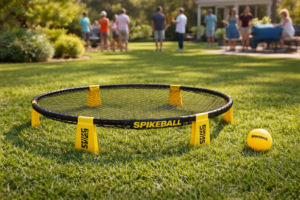
- What You Need to Play Spikeball
- Spikeball Vocabulary (Key Terms to Know)
- Spikeball Rules Explained
- How to Play Spikeball (Simple Step-by-Step)
- Tips for Having Spikeball at an Event
- Where to Rent Spikeball
What Is Spikeball?
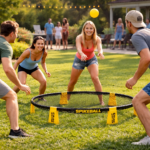
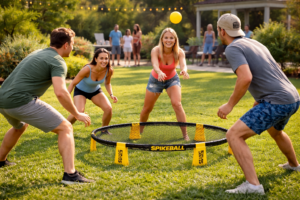
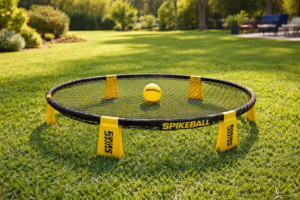
Spikeball, also known as roundnet, is a fast-paced outdoor game played by two teams of two around a small, circular net set close to the ground. The goal is simple: hit the ball off the net so the opposing team can’t return it within three touches.
What makes Spikeball different from games like volleyball is that there are no sides. Players can move freely around the net in all directions, which keeps the game active and unpredictable.
It’s easy to learn, quick to set up, and works well for everything from casual backyard games to larger events where you want something interactive that gets people moving.
What Types of Events Are Best for Spikeball?
Spikeball works best at events where people want to move, interact, and jump into something easy. It requires little setup, and most people can learn the basics in just a few minutes, making it a strong fit for casual, social environments.
- Backyard parties are a natural match. Guests can rotate in and out of games without needing a full tournament setup, and it adds energy without taking over the whole event.
- Beach days and outdoor gatherings are also ideal. Spikeball was built for open spaces, and sand or grass gives players room to move safely.
- Low-pressure team activity for company picnics and corporate events. It encourages interaction without forcing participation, which is helpful when you have a mix of personalities.
- College events and school functions are another great fit. The game is competitive enough to keep people engaged but simple enough for beginners to join in quickly.
If your goal is to create a relaxed, interactive atmosphere where guests naturally engage with each other, Spikeball is a strong addition to the setup.
Spikeball Rules Explained
Spikeball is easy to pick up once you understand the basic rules. The game moves quickly, but most rallies follow the same simple structure.
How to Start the Game
The game begins with a serve. Teams line up across from each other around the net. One player serves the ball by hitting it down onto the net so it bounces up toward the opposing team.
The receiving team must be ready to return it after the bounce.
Serving Rules
- The server stands a few feet away from the net (typically about 6 feet)
- The ball must hit the net cleanly, not the rim
- The serve should travel directly to the opposing team
- If the serve is not playable, it is a fault
To keep things simple at casual events, most groups allow one clean serve to start play.
During a Rally
Once the ball is served, the rally begins.
- Each team gets up to 3 touches to return the ball to the net
- Teammates can pass the ball to each other before hitting it onto the net
- Players can move anywhere around the net during play
The goal is to hit the ball off the net so the other team cannot return it within their three touches.
What Counts as a Fault
A point is scored when the opposing team makes a mistake. Common faults include:
- The ball hits the ground
- The ball hits the rim instead of the net
- A team uses more than 3 touches
- The ball does not bounce back up off the net
When a fault happens, the other team earns a point and serves next.
How to Play Spikeball (Simple Step-by-Step)
Here’s how to play Spikeball:
-
- Set Up: Place the net on a flat surface with space around it.
- Pick Teams: 2 vs 2. Teammates stand across from each other.
- Serve the Ball: Hit the ball down onto the net to start the point.
- Return the Ball: The other team has up to 3 hits to return it to the net.
- Keep It Going: Teams go back and forth, using up to 3 hits each time.
- Point Ends on a Fault: A point is scored if the ball hits the ground, the ball hits the rim, or a team uses more than 3 hits
- New Serve: The team that won the point serves next.
That’s it. Once people play one round, it clicks fast.
Tips for Having Spikeball at Your Event
Spikeball is easy to set up, but a few small details can make a big difference in how much people actually play and enjoy it.
Give It Space
Avoid placing it near tables, chairs, or high-traffic walkways where guests could accidentally step into play. Giving the game enough space not only prevents collisions but also makes the experience feel smoother and more fun for everyone involved.
Choose The Right Surface
Other Game Blogs:
16 Unique Lawn Game Rental Ideas for Parties & Events
Cornhole Rules | Horseshoes Rules | Ladder Golf Rules|Ring Toss (Festival & Carnival-Style)