







What You Need to Play Cornhole
One of the reasons cornhole is so popular is how simple it is to set up. You don’t need much — just a few essentials and a flat surface. And it’s super affordable to rent for events.
Here’s what you need:
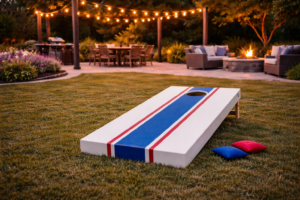
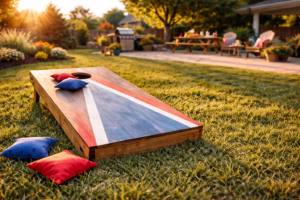
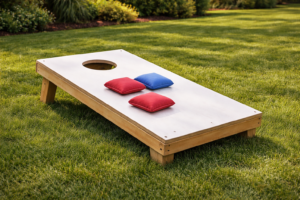
- 2 cornhole boards: Regulation boards measure 48 inches long by 24 inches wide with a 6-inch hole centered 9 inches from the top.
- 8 cornhole bags: Four bags per team. Regulation bags are 6×6 inches and typically filled with resin or corn.
- 2 to 4 players: Cornhole can be played one-on-one (singles) or in teams of two (doubles).
- A flat playing area: Grass, turf, pavement, or any level outdoor space works.
That’s it! No complicated equipment or special setup tools needed.
How to Set Up Cornhole (Board Distance & Layout)
Cornhole is simple to set up, but getting the spacing right makes a big difference.
Board Placement
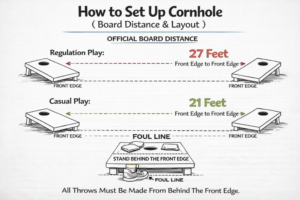
Place the two boards directly facing each other on a flat surface. The holes should be at opposite ends, creating a straight throwing lane between them.
Official Distance Between Cornhole Boards
- For regulation play: 27 feet from the front edge of one board to the front edge of the other
- For casual backyard games or younger players: 21 feet front edge to front edge
If you don’t have a tape measure, pacing it out evenly works fine for non-competitive play.
Player Positions
- In singles, players stand at opposite boards and walk to the other side after each round.
- In doubles, teammates stay at opposite boards for the entire game.
All throws must be made from behind the front edge of the board (this acts as the foul line).
How to Play Cornhole (Rules Explained Clearly)
Once the boards are set up, playing cornhole is simple. The goal is to toss your bags onto the board or through the hole to score more points than your opponent.
1. Start the Game
Players divide into either singles (1 vs. 1) or doubles (2 vs. 2).
Each team gets four cornhole bags. Players take turns tossing their bags toward the opposite board.
Teams alternate throws until all eight bags have been thrown.
This is called a round or inning.
2. How to Throw
Cornhole bags must be thrown underhand from behind the front edge of the board.
Players should:
- Keep both feet behind the foul line
- Alternate throws with the opposing player
- Aim for the board or the hole
If a player steps past the front of the board while throwing, it counts as a foul, and the bag does not score.
3. Cornhole Scoring
Points are awarded based on where the bag lands:
- 3 points — bag goes through the hole
- 1 point — bag lands and stays on the board
- 0 points — bag hits the ground or slides off
Cornhole uses cancellation scoring. This means the points from each team cancel each other out each round.
Example:
- Team A scores 7 points
- Team B scores 4 points
To award points for the round, subtract Team B’s score from Team A’s. Team A earns 3 points for the round.
More on this in the next section!
4. How to Win
Games are typically played to 21 points.
The first team to reach 21 or more at the end of a round wins the game.
Some competitive games require teams to win by at least 2 points, but many casual games simply end once a team reaches 21.
Cornhole Scoring Examples + Downloadable Cornhole Score Sheet
Cornhole uses cancellation scoring, which means the points from each team cancel each other out at the end of every round.
Only the difference in points is added to the scoreboard.
Quick Scoring Reference
- 3 points — bag goes through the hole
- 1 point — bag stays on the board
- 0 points — bag touches the ground
Only the point difference between teams counts each round.
Example
Cornhole Scoring Example
| Team | Bags in Hole | Bags on Board | Total Points |
| Team A | 2 | 1 | 7 points |
| Team B | 1 | 1 | 4 points |
Result:
Team A earns 3 points for the round.
Why? Because 7 − 4 = 3.
Team B does not receive points for that round.
Common Cornhole Terms
As you play more cornhole, you’ll start hearing a few common terms used by experienced players. Here are some of the most popular ones.
- Airmail: Airmail occurs when a bag goes directly into the hole without touching the board first.
- Hanger: A hanger is a bag that lands on the edge of the hole and partially hangs over it. It hasn’t scored yet, but it’s in a great position to drop in.
- Blocker: A blocker is a bag that sits in front of the hole, making it harder for the opposing team to slide their bags in.
- Slide: A slide shot is when a player intentionally lands a bag on the lower part of the board so it slides upward into the hole.
- Four-Bagger: A four-bagger happens when a player throws all four bags in a round, and every one of them goes through the hole.
You’ll hear these phrases often in tournaments, leagues, and friendly backyard matches.
Cornhole for Parties and Events
Here are a few tips for setting up cornhole at events:
Leave Plenty of Space Between Boards
If you’re setting up multiple cornhole games, leave enough space between lanes so players can throw comfortably without interfering with other games.
A good rule of thumb is to allow at least 10–12 feet of space between boards when setting up several games.
Place Boards Near Social Areas
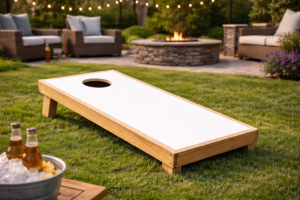
Cornhole works best when it’s close to places where guests naturally gather — like seating areas, drink stations, or patios. This encourages people to join a game casually without feeling like they need to commit to a full tournament.
Consider Running a Mini Tournament
For larger events, a simple cornhole tournament can add structure and excitement. You can rotate teams every round or set up a small bracket for friendly competition.
Prizes don’t have to be big — even small awards can make the game more engaging for guests.
Keep Scoring Simple
At parties, many hosts skip strict scoring and just play casual rounds. If you want to track winners, a small whiteboard or scoreboard nearby makes it easy for players to keep track.
Rent Cornhole Instead of Buying & Storing
If you only host a few times a year, you can rent cornhole for an affordable price instead of purchasing and having to store a bulky game. This is an especially great option if you want to rent for events like wedding after parties, backyard parties, or corporate events.
When you rent, you can simply pick it up and return the game yourself or have it delivered to your event site for your convenience.
Cornhole Strategy Tips for Beginners
Cornhole is easy to learn, but a few simple strategies can help you improve quickly and make the game more competitive.
Focus on Consistent Throws
Instead of trying to throw hard, focus on a smooth, consistent underhand motion. Most experienced players aim for a gentle arc that lets the bag land softly on the board.
Consistency is often more important than power.
Aim for the Center of the Board
If you’re new to cornhole, aim for the middle of the board rather than the hole. Bags that land on the board still score points, and they often slide closer to the hole.
Use the Board to Your Advantage
Sometimes the best strategy is simply getting your bag onto the board. Even if it doesn’t go in the hole, it can:
- Score a point
- Block your opponent’s shot
- Be pushed into the hole by later throws
Watch Your Opponent’s Bags
If your opponent has a bag sitting near the hole, you can try to knock it off the board or push it away. This reduces their chances of scoring.
Stay Relaxed and Have Fun
Cornhole is meant to be a social game. Relax, take your time with each throw, and enjoy the competition.
With a little practice, your throws will become more accurate and consistent.